Příspěvky

Reprogramming "old" Sennheiser Microphone - Part 5 - Writing to Memory and Testing

Obrázek
 Writing and testing  I have table with the values that should be written to into the EEPROM which needed some splitting and padding in order to get it into correct format. Then I added addresses on which data should be written. In this case it should be first 16 channels, that all I need even if there is possible to store up to 32, but the 820-830MHz bandwidth is too narrow for more than 16 channels.  Transformed the addresses and values to array string, odd is address even is value. But I wanted to start with just one value in order to do make any mistake and test if everything is working so I prepared program to write data to first and second bank. Plug the ESP32 on the I2C bus and wait until there is no communication. Push the button, then after removing the ESP32 turn off and on the mic. Which should not be necessary. Set the first channel that I wanted to overwrite and it show this new, correct frequency! But when tuning the receiver to see if everything is working ...

Reprogramming "old" Sennheiser Microphone - Part 4 - PLL

Obrázek
 PLL At the beginning when I was looking at the I2C communication I have found out which parts of it talks with PLL, but then I carry on as I did not expect it I will need to understand it better and also since I have very vague idea about what PLL actually is. But now I have to find out in order to compute and load proper data for it into the memory. From the microphone schematics I got the basic idea Red line is quite clearly audio input from the AF microphone part. So its the signal that drives the modulation. Green line is HF output that goes to the HF amplifier stage, thats also quite clear Blue line looks like output from PLL that drives the VCO Yellow is line that goes back from the output to the Prescaler which I have found out is fancy word for frequency divider and then into the PLL  What I thougth PLL is: IC into which you send some f1 and you will get f2 thats locked to the f1 phase. But looking to the datasheet the working frequency of this PLL is actually quite ...

Reprogramming "old" Sennheiser Microphone - Part 3 - EEPROM

Obrázek
 EEPROM   So, I was able to connect to I2C on the board, see the communication and understand it, little bit. Now the question is, If I'm also able to read the EEPROM without removing it from PCB. Chip is quite small and de/soldering would be painful. Every time you desolder SMT component there is quite high risk that you might remove also the layer of copper which results in destruction of PCB, or in the best case, painful repair.  For the communication the easiest way is to use Arduino board and I2C library, since I have on hand ESP32 I will use this one with Arduino IDE which makes it simple. Thanks to internet there is already a guy who was playing with this particular EEPROM and Arduino, so it makes the effort even easier. Simple Copy-Paste with some modifications to read position 0x10 since I know what is stored there from the I2C communication.  For physical connection I used logic analyzer probes just connected them to the ESP32. Uploaded the program, t...

Reprogramming "old" Sennheiser SKM 3072-U - Part 2 - I2C

Obrázek
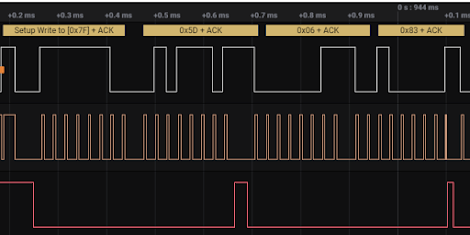
 Understanding what is going on I2C In the previous step I hooked up my logic analyzer on the I2C to see how the communication inside the mic actually looks like. Partially because I want to understand better how to reprogram the microphones EEPROM but also because I'm just curious and want to see what is really going on. After powering up the microphone this is the output from I2C. write to 0x3E ack data: 0xE0 0xC8 0xF0 0x00 0x00 0x00 0x00 0x00 0x00 0x00 0x00 0x00  write to 0x3E ack data: 0xE0 0x00 0x00 0x00 0x00 0x00 0x00 0x00 0x00 0x00 0x00 0x00  write to 0x50 ack data: 0x10  read to 0x50 ack data: 0x11 write to 0x51 ack data: 0x1A  read to 0x50 ack data: 0xA9 write to 0x51 ack data: 0xB3  read to 0x50 ack data: 0x1F write to 0x51 ack data: 0xAE  read to 0x50 ack data: 0x03 write to 0x51 ack data: 0xAF  read to 0x50 ack data: 0x20 write to 0x51 ack data: 0xAC  read to 0x50 ack data: 0xFC write to 0x51 ack data: 0xAD  read to 0x50 ack ...

Reprogramming "old" Sennheiser SKM 3072-U - Part 1 - Intro

Obrázek
I'm somehow interested in audio production. But not it more my pet hobby, nothing that would generate decent income. This means I usually don't want to spend much of money on the equipment.  Right about now is quite good time to get some old-ish wireless audio equipment for decent price. The reason is that there was change ( info ) in wireless bands and bands that used to be free before are not available for the professional audio anymore. That means that lot of productions are ditching their stuff to buy new one, compatible. But not all the old stuff is useless as some of it can be reprogrammed. There is tight window from 822 to 830 MHz in EU. This window is quite narrow, but at least it should granted all the time for professional audio. Other option is to go below 700Mhz, but then you might get into collision with local TV transmitter. Therefore I settled for the narrow band since I don't plan to use too many transmitters at once and this should work for me well. My movi...